
Clay County Deed Types
Deeds in Clay County are filed with the Judge of Probate, the local recording office under Alabama law. Every deed names the parties. It describes the land and the interest conveyed. Many instruments carry more. A prior reference, consideration language, easements, and a marital-status recital required for covered individual grantors can all appear in the text. Read the full deed, since an index entry or GIS citation is only the route to the document.
Labels like warranty or quitclaim help organize a search. The clauses inside the deed control its meaning. The public Clay recording screen keeps its document choices behind the account workflow, so the types listed here may not all appear as online categories.
| Deed Type | What It Does | Common Use |
|---|---|---|
| Warranty deed | Conveys the stated interest with covenants | Ordinary sale |
| Quitclaim deed | Conveys whatever interest the grantor holds | Interest cleanup or family transfer |
| Executor or personal-representative deed | Uses estate authority to convey | Probate sale |
| Deed under power of sale | Records a foreclosure-related conveyance | Power-of-sale process |
| Tax deed or tax-sale instrument | Documents a step after delinquency procedures | Tax-sale chain |
A deed is a conveyance. A mortgage, judgment lien, lis pendens, restriction, or easement can burden the same land without ever being the purchase deed. Treat releases, assignments, and corrections as separate entries.
Clay Probate Recording Access
The Clay Probate online service separates land records from probate case records. The recording login states that online research requires a free account starting August 1, 2026. Public pages show no grantor-grantee form. Indexed start year, image range, deed-type choices, and copy fees stay hidden too. Ask Probate about those gaps. Fill nothing in by guesswork.
Remote access usually just needs the free account. Create it through the official signup route. For certified instruments, older books, a hidden image, or a murky citation, contact the Judge of Probate at 256-354-2198 or visit 25 Courthouse Square in Ashland. Bring names, a date range, a parcel or legal-description clue, and any book and page.
The official recording research signup is the entry point for that account.
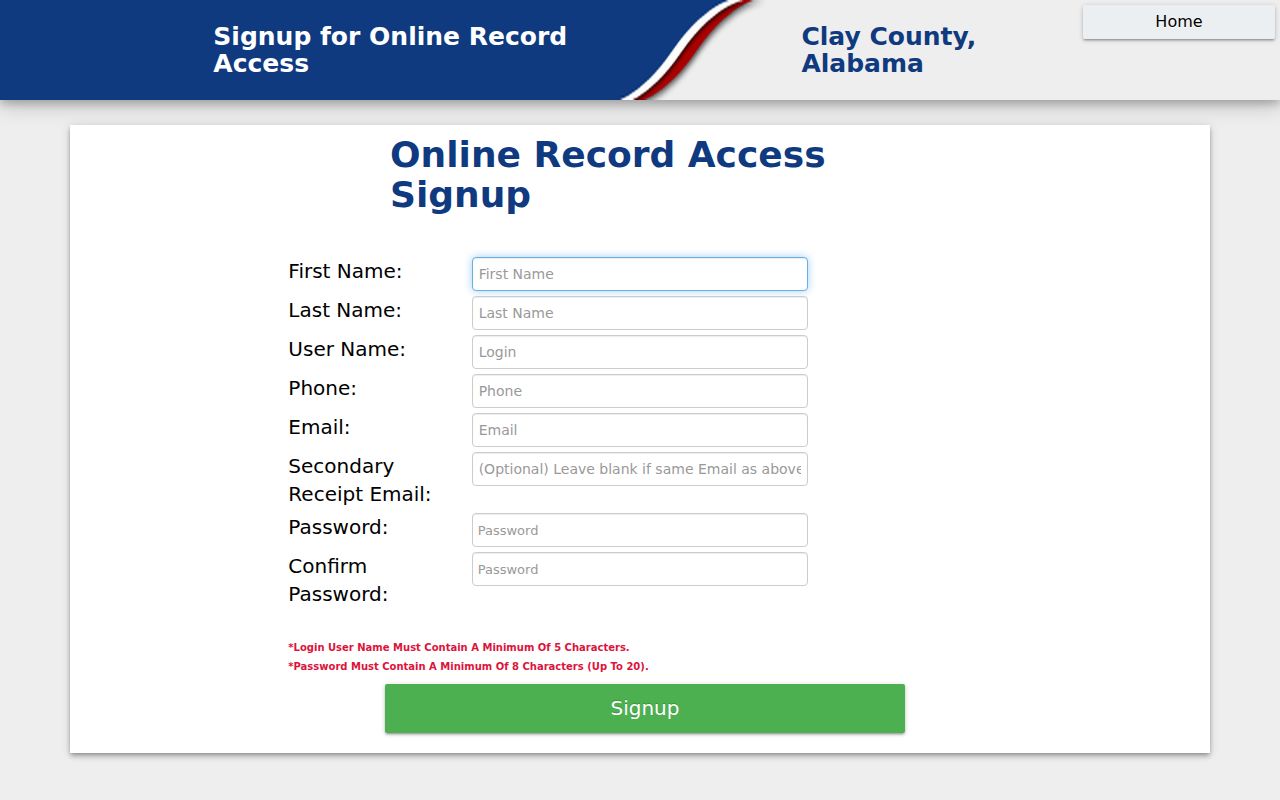
The signup form confirms the free-account route without revealing hidden search fields or historic coverage.
Trace Clay Grantors and Grantees
A chain runs from owner to owner. Start with the latest deed reference on the Clay GIS card or a Probate result. Pull the document. Identify the grantee who received the interest and the grantor who conveyed it. Search that grantor as an earlier grantee to step back in time. Repeat, matching land descriptions and prior references each time. Names alone are weak evidence when people share one. An estate, trust, or company can hold title, too.
- Copy the current GIS deed book, page, date, and legal-description text.
- Pull the instrument and record its grantor, grantee, and prior reference.
- Search the grantor as a grantee in an earlier date range.
- Compare each land description and move to books or microfilm when remote coverage ends.
- Grantor
- The party conveying the stated interest.
- Grantee
- The party receiving the stated interest.
- Chain of title
- The ordered sequence of recorded conveyances tied to the same land.
- Book and page
- The Clay reference used on GIS cards and older record citations.
GIS Bridges to Clay Deeds
Clay GIS cards often print deed book, page, and date beside parcel and assessment facts. That reference is the fastest bridge from an address to deed records. Search the GIS form by address, owner, parcel, PIN, or section-township-range. Deed type, book, page, deed-date, and plat controls are also offered.
Copy the reference exactly as printed. Leading letters and zeros matter. One sample shows B0368/P0000150 dated 2010. Another uses deed 422-30. Those samples show format variety, not coverage promises. GIS legal text may be abbreviated. The recorded instrument remains the source for the full description and its clauses.
Clay Books Reach the 1860s
The ADAH County Records catalog lists 17 Clay deed-record entries created by the Probate Judge. The earliest is volume F. It begins September 23, 1861. Entries run through a volume G ending September 30, 1908, and one G volume spanning 1879 to 1890 also holds mortgage records.
This catalog describes historical holdings, not the start year of the online Clay deed index. Volume letters repeat. Pair each with its dates and reel codes. One D entry lists its dates in reverse order, an archival quirk worth verifying before citation. ADAH notes that most originals remain in the originating office.
ADAH handles remote requests that generally search up to four sources for one surname. Turnaround runs two to three weeks. Computer, microfilm, flash-drive, and staff-research charges differ. Confirm the current fee for the format you want.
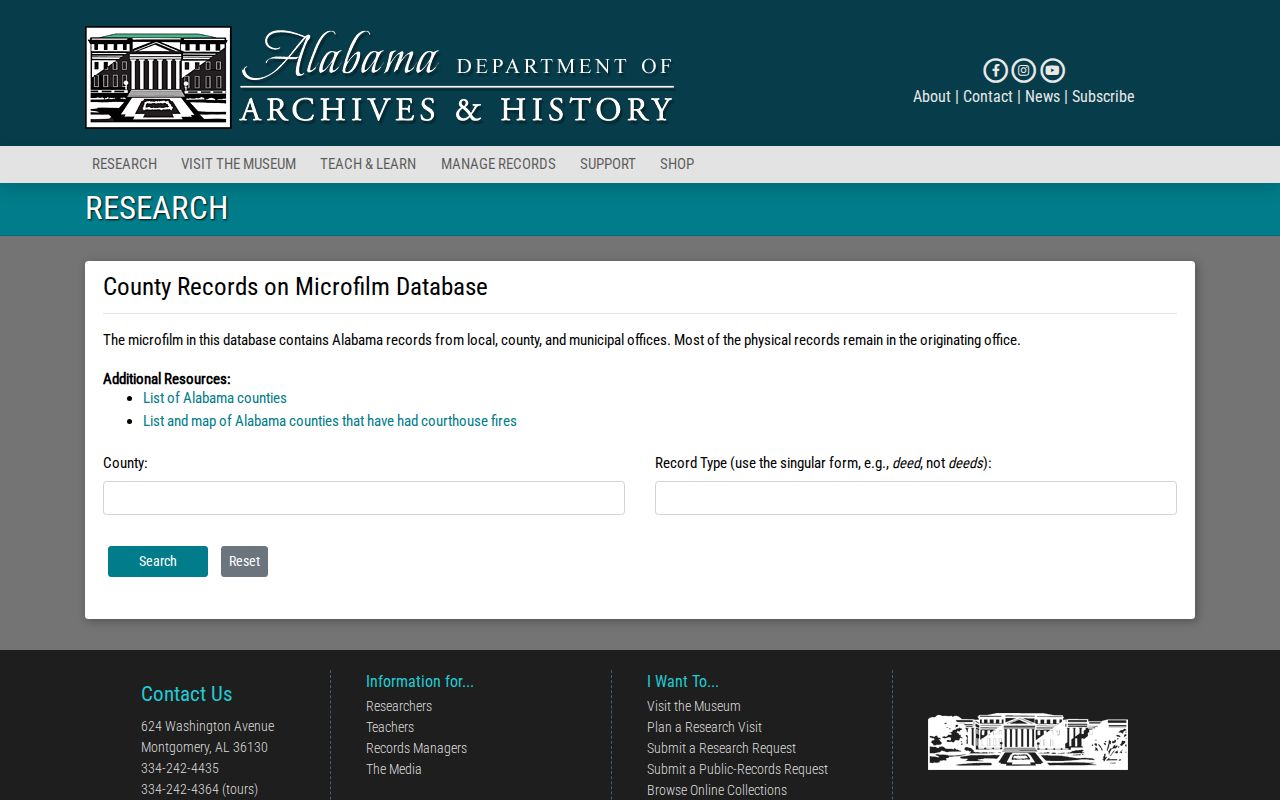
When a modern chain reaches past visible Probate access, this catalog is the historical fallback.
Clay Plats and Descriptions
Keep the chain tied to one piece of land. Compare parcel number, acreage, section-township-range, and metes-and-bounds text. Check the subdivision, lot, block, plat citation, roads, and adjoining owners when they appear. Parcel numbers can change. The legal description and prior references build the stronger bridge across time.
Approval and recording are distinct steps for subdivisions. Lineville's 2017 regulations require an approved final plat suitable for recording with the Clay County Probate Judge. City zoning maps add planning context but are not recorded plats, so ask Probate for the plat when lot identity matters and use a surveyor for a boundary opinion.
Estates Can Break the Chain
A clean seller-to-buyer chain can stop cold. Death interrupts it. So can an estate, a court order, a tax process, or a company change. Clay Probate keeps probate cases apart from land records, so pull the estate file first to identify the personal representative and confirm the authority to convey. Then check the property records to see which deed was actually recorded; owner strings on an assessment roll never prove heirs.
Court actions deserve the same two-source care. A quiet-title judgment, partition order, or foreclosure docket may explain how authority arose, while a Probate filing ties the event to the deed records. The Clay Circuit Clerk offers a public terminal, and remote Alacourt search is paid. Search the parties first. Then read the legal description and the outcome.
Clay Recording Taxes and Fees
Alabama's recordation-tax guidance covers two rates. Deeds cost fifty cents per five hundred dollars of value. Mortgages, deeds of trust, and conditional-sale contracts are one category. These cost fifteen cents per one hundred dollars of indebtedness. A Clay-specific statute adds two dollars for each real-property instrument filed with a probate judge. That two dollars sits on top of other charges. These figures cover recording only. They are not a fee for searching or downloading a deed.
Final totals vary. Page counts matter. So do taxes, certification, and county-authorized additions tied to the instrument. The Clay portal's public page mentions a processing charge for online renewals. That charge has nothing to do with deed records. Ask Probate for the current copy and certification schedule before sending payment. Confirm before paying.
Request a Clay County Deed
Start online when the instrument sits in the account system and the image is viewable. Fields or images hidden? Call or visit Clay Probate. A mail inquiry goes to PO Box 1120, Ashland, Alabama 36251; before sending anything, confirm the wording, the fee, the payment method, the return envelope, and whether certification is needed. The office publishes no current copy-fee schedule, so no total can be quoted here.
Give the staff a narrow request. Include grantor and grantee, an approximate date, the deed type if known, book and page, and a legal-description or parcel clue. A plain copy works for research. A certified copy is the choice when an official reproduction is required. Older material may call for a deed book or ADAH microfilm, while a current instrument may be reachable through the recording account.
Recorded, not guaranteed. Clay County deed records show filed instruments; they do not establish that no unrecorded claim or title defect exists.